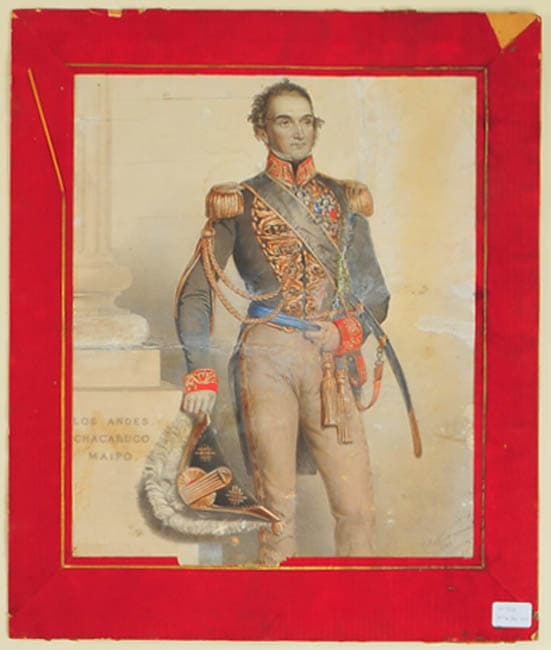
John Thomond O'Brien
Juan Thomond O'Brien · Also known as General O'Brien, Don Juan O'Brien
The Baltinglass-born aide-de-camp to San Martín, who tried to recruit Irish emigrants in the 1820s, was jailed by Rosas and now lies in Mendoza.
- Born
- reported, Baltinglass, Co. Wicklow
- Died
- reported, Lisbon
Irish link
Irish link: DocumentedBorn in Baltinglass, Co. Wicklow, according to Edmundo Murray's dictionary entry and Tim Fanning's 2020 biography; an older text gives Mallow, Co. Cork.
By most sources John Thomond O'Brien was born in 1786 in Baltinglass, Co. Wicklow, the son of Martin O'Brien and Honoria O'Connor. Edmundo Murray's dictionary entry has him reaching Buenos Aires in 1812 to open a merchant house before joining the army; Tim Fanning's 2020 biography says he emigrated in the 1810s to profit from the textile trade and enlisted as a cavalry officer in 1813. He fought in Uruguay under General Soler, joined San Martín's Mounted Grenadiers in 1816 and, after Chacabuco, was made captain and aide-de-camp to San Martín. He fought at Cancha Rayada and Maipú and in the Peru campaign, became a colonel in 1821 and, in Peru, a general in 1835. Fanning adds that he launched a ship on Lake Titicaca and organised Irish support in Buenos Aires for O'Connell's Catholic Emancipation campaign.
In 1826 Buenos Aires figures commissioned him to recruit Irish immigrants. After two years in Ireland he had little success, but he met John Mooney, whose emigration Murray describes as the start of the Irish chain from the Westmeath, Longford and Offaly area. McKenna says O'Brien insisted that emigrants have their own chaplain and physician, and that he was to recruit only "moral and industrious" people.
He fell out with Rosas and was imprisoned in the 1830s. Murray says he was released after pleas from Rosas's daughter and British diplomatic pressure; the Mendoza government says he had been serving Santa Cruz's Peru–Bolivian Confederation, then at war with the Argentine Confederation. In the 1840s he represented the Montevideo government in London and Paris, published a London pamphlet on the River Plate war and navigation in 1845 and was Uruguay's special envoy to the United Kingdom in 1848. The Mendoza government also records accounts that he was a British agent sent to watch San Martín and Alvear.
He died in Lisbon on 1 June 1861 on his way back to South America. His remains were brought to Argentina in 1938 with an official funeral, and a town in Bragado bears his name. In January 2017, for the bicentenary of the Crossing of the Andes, they were moved from Recoleta to the Campo Histórico El Plumerillo in Mendoza.
Where sources disagree
Published sources give different versions. Here is each one with its source, and the wording we use.
His birthplace and year
Baltinglass, Co. Wicklow, 1786.
Source: Edmundo Murray, O'Brien, John Thomond, DILAB (SILAS), 7 May 2009(opens in a new tab)Mallow, Co. Cork, 1787.
Source: Villanova Digital Library item on John Thomond O'Brien, 11 October 2026(opens in a new tab)
We say: We say Baltinglass, Co. Wicklow, 1786, following Murray and Fanning, and note the Mallow claim as an older variant.
When he arrived and when he enlisted
Arrived in 1812 as a merchant; joined the Mounted Grenadiers in 1816.
Source: Edmundo Murray, O'Brien, John Thomond, DILAB (SILAS), 7 May 2009(opens in a new tab)Emigrated in the 1810s; enlisted as a cavalry officer in 1813.
Source: Tim Fanning, Don Juan O'Brien, Cork University Press, via Project MUSE, 2020(opens in a new tab)Arrived in 1816.
Source: Villanova Digital Library item on John Thomond O'Brien, 11 October 2026(opens in a new tab)Arrived towards the end of the eighteenth century.
Source: Patrick McKenna, Nineteenth Century Irish Emigration to, and Settlement in, Argentina, MA thesis, Maynooth, ch. 4, 1994(opens in a new tab)
We say: We say he arrived in the 1810s as a merchant and joined the army soon after.
The dates of his recruiting trip to Ireland
Commissioned in 1826; two years in Ireland.
Source: Edmundo Murray, O'Brien, John Thomond, DILAB (SILAS), 7 May 2009(opens in a new tab)Went back to Ireland with Thomas Armstrong in 1826.
Source: Edmundo Murray, Armstrong, Thomas St George, DILAB (SILAS), 1 December 2003(opens in a new tab)Recruited in Ireland in 1827–28.
Source: Pat Nally, Los Irlandeses en la Argentina, Familia 2(8), 1992(opens in a new tab)
We say: We say 'in the late 1820s'.
Sources
- Source: Edmundo Murray, O'Brien, John Thomond, DILAB (SILAS), 7 May 2009(opens in a new tab)
- Source: Tim Fanning, Don Juan O'Brien, Cork University Press, via Project MUSE, 2020(opens in a new tab)
- Source: Gobierno de Mendoza, Comenzó el traslado de los restos del general O'Brien a Mendoza, 19 January 2017(opens in a new tab)
- Source: Patrick McKenna, Nineteenth Century Irish Emigration to, and Settlement in, Argentina, MA thesis, Maynooth, ch. 4, 1994(opens in a new tab)
- Source: Edmundo Murray, Armstrong, Thomas St George, DILAB (SILAS), 1 December 2003(opens in a new tab)
- Source: Pat Nally, Los Irlandeses en la Argentina, Familia 2(8), 1992(opens in a new tab)
- Source: Villanova Digital Library item on John Thomond O'Brien, 11 October 2026(opens in a new tab)