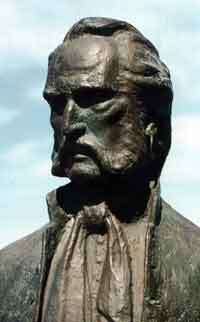
 Bronze bust
Peter Campbell
Pedro Campbell
An Irish soldier of the 1806 invasion who deserted, turned gaucho and tanner, and commanded Artigas's river fleet; Uruguay remembers him as the founder of its navy.
- Born
- reported, Ireland
- Died
- claimed
Irish link
Irish link: DocumentedIrish-born, according to Giuffré and Murray; a review of Fanning's book calls him Tipperary-born, which no sound source has confirmed.
Peter Campbell was born in Ireland in 1780, according to the historian Mercedes Giuffré and to Edmundo Murray's dictionary entry; Murray says little is known of his early life. A review of Tim Fanning's book Paisanos calls him Tipperary-born, a claim the research has not confirmed in a sound source. A tanner by trade, he joined the British army for reasons unknown and came to the River Plate with the 71st Regiment in the 1806 invasion. He deserted in Buenos Aires, escaped to Corrientes, went back to tanning and joined Artigas's army, adopting gaucho ways. One of the Robertson brothers, who met him, described him as honest but quarrelsome, with earrings and gaucho dress.
From 1814 he built river squadrons for Artigas, crewed by Indigenous and mestizo recruits from Misiones and the Chaco, and fought the Buenos Aires fleet until his last ships were sunk in 1820. Murray records that he was deputy governor of Corrientes after 1819. John de Courcy Ireland calls him an Irish deserter from Popham's expedition who founded Uruguay's small navy, and Murray also calls him the founder of the Uruguayan navy. A Tipperary local-history site says Artigas appointed him first commander of the Uruguayan fleet on 21 August 1818, and the Uruguayan navy is said to award a medal in his name; both details were seen in search summaries only.
He fled to Paraguay, where the dictator Francia spared him and let him work as a tanner. Giuffré says he died there in 1832; Murray gives about 1832, with the place disputed. Campbell sits awkwardly in an Argentine story. He is mostly a figure of Uruguay and Corrientes, and he fought against Buenos Aires.
Where sources disagree
Published sources give different versions. Here is each one with its source, and the wording we use.
Where in Ireland he came from
Little is known of his early life.
Source: Edmundo Murray, Campbell, Peter, DILAB (SILAS), 1 January 2006(opens in a new tab)Tipperary-born.
Source: Belfast Media, review of Tim Fanning's Paisanos, 21 March 2021(opens in a new tab)
We say: We say 'Irish-born' and leave the county open.
When and where he died
Died in Paraguay in 1832, working as a tanner under Francia.
Source: Mercedes Giuffré, Tras las huellas de los prisioneros irlandeses radicados en el Plata, Ideas suplemento V, 15, 2024(opens in a new tab)Died about 1832; place and date disputed.
Source: Edmundo Murray, Campbell, Peter, DILAB (SILAS), 1 January 2006(opens in a new tab)
We say: We say 'died about 1832'.
Sources
- Source: Mercedes Giuffré, Tras las huellas de los prisioneros irlandeses radicados en el Plata, Ideas suplemento V, 15, 2024(opens in a new tab)
- Source: Edmundo Murray, Campbell, Peter, DILAB (SILAS), 1 January 2006(opens in a new tab)
- Source: John de Courcy Ireland, Almirante William Brown, History Ireland 9:3, September 2001(opens in a new tab)
- Source: Belfast Media, review of Tim Fanning's Paisanos, 21 March 2021(opens in a new tab)
- Source: Hidden History, On this day in Tipperary: 21 August, 11 October 2026(opens in a new tab)