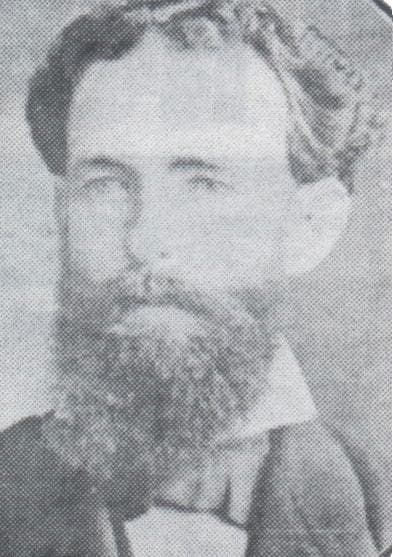
Eduardo Casey
The Irish-Argentine land developer who founded Venado Tuerto, first exported live cattle to England and was ruined in the crisis of 1890.
- Born
- reported, Estancia El Durazno, Lobos, Buenos Aires province
- Died
- reported, Buenos Aires
Irish link
Irish link: DocumentedArgentine-born son of Lawrence Casey of Co. Westmeath and Mary O'Neill of Co. Wicklow, according to SILAS.
Eduardo Casey was born on 20 April 1847 at the estancia El Durazno in Lobos, Buenos Aires province, the son of Lawrence Casey of Co. Westmeath and Mary O'Neill of Co. Wicklow, according to the SILAS dictionary entry by José Bernardo Wallace. The historian María Eugenia Cruset calls him an Irish immigrant and a member of the Buenos Aires upper bourgeoisie; since he was Argentine-born, this site calls him Irish-Argentine.
He belongs to the second phase of Irish settlement, the land speculation of the 1880s rather than the shepherding of the 1840s. SILAS says he bought 72 leagues, about 130,000 hectares, at Venado Tuerto in southern Santa Fe, and that he was the first to export live cattle to England. He founded the town of Venado Tuerto, and on 15 March 1883 he sold eight leagues of southern Santa Fe land to the Wexford-born estanciero John James Murphy. The town of Casey, in Guaminí partido, is named after him. The Irish were buying cheaper land on a moving frontier: by the 1895 census the weight of the community had shifted from the old partidos near Buenos Aires towards Arrecifes, Pergamino and Santa Fe.
The crisis of 1890 ruined him. SILAS records that he repaid his small investors, and that he died in Buenos Aires on 16 June 1906 by suicide on the railway tracks. His remains were reburied at Venado Tuerto on 26 April 1973. The town kept its Irish associations into the twentieth century: the polo trophy Copa Arturo Kenny, named for a member of Argentina's 1924 Olympic team, is played there each year.
Where sources disagree
Published sources give different versions. Here is each one with its source, and the wording we use.
Casey's status: immigrant or Argentine-born
An Irish immigrant and a member of the Buenos Aires upper bourgeoisie.
Source: Cruset, Trabajos y Comunicaciones (2021), 2021(opens in a new tab)Born at Lobos in 1847 to Irish parents.
Source: SILAS DILAB, José Bernardo Wallace, Casey, Eduardo (pub. 1 Nov 2005), 1 November 2005(opens in a new tab)
We say: We say 'the Irish-Argentine founder of Venado Tuerto'.
Sources
- Source: SILAS DILAB, José Bernardo Wallace, Casey, Eduardo (pub. 1 Nov 2005), 1 November 2005(opens in a new tab)
- Source: Cruset, Trabajos y Comunicaciones (2021), 2021(opens in a new tab)
- Source: Edmundo Murray, From Kilrane to the Pampas, SILAS (2003, updated 20 Apr 2004), 20 April 2004(opens in a new tab)
- Source: Brian Ó Doibhlin, Studi irlandesi 11 (2021), on Irish place names, 2021(opens in a new tab)
- Source: SILAS, Irish Settlers in Argentina (c. 2006), 2006(opens in a new tab)
- Source: Olympedia, Arturo Kenny (accessed 11 Oct 2026), 11 October 2026(opens in a new tab)