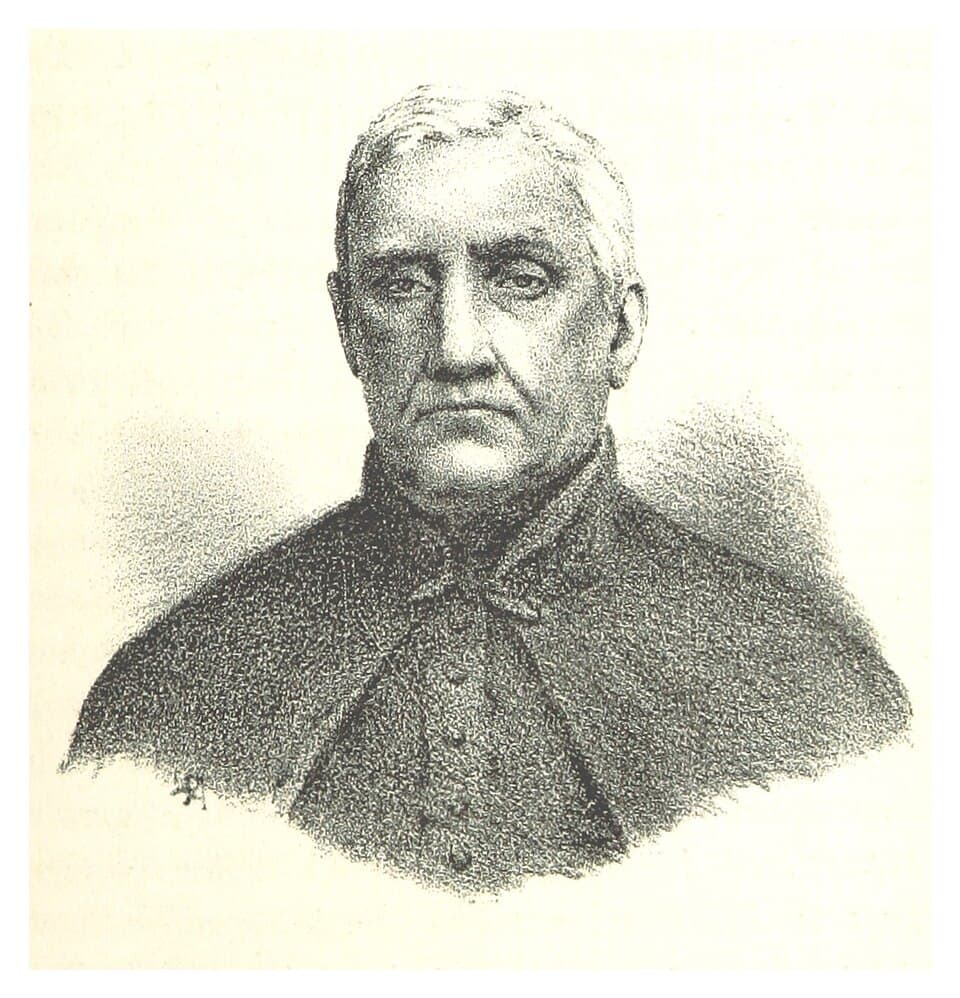
Anthony Fahy
Antonio Fahy · Also known as Fr Anthony Dominic Fahy OP, Padre Fahy, Father Fahy
The Loughrea Dominican who was chaplain, banker and matchmaker to the Irish of Buenos Aires from 1844 to 1871, and a supporter of Rosas.
- Born
- reported, Loughrea, Co. Galway
- Died
- reported, Buenos Aires
Irish link
Irish link: DocumentedBorn in Loughrea, Co. Galway, according to Casey, Canal 26 and Murray's dictionary entry.
Anthony Fahy was born in Loughrea, Co. Galway, in 1805 by most accounts; Juan José Delaney gives 1804. He took the Dominican habit in 1828, studied at San Clemente in Rome and was ordained in 1831. After missionary years in Kentucky and Ohio he became prior of Black Abbey, Kilkenny. In 1843 Archbishop Murray of Dublin named him Irish chaplain to Buenos Aires, to help the ailing Fr Patrick O'Gorman. McKenna says the archbishop was worried that Irish settlers around Chascomús were marrying into local society. A contemporary newspaper, The British Packet, recorded his arrival on the brig Plata from Liverpool on 11 January 1844, when the community was put at 3,500.
For most of his ministry he lived in a house given free by the merchant Thomas Armstrong. He described himself as consul, postmaster, judge, pastor, interpreter and provider of work for his people. McKenna describes him holding immigrants' savings and property in his own name, acting as their banker and agent, matching land sellers and buyers, and in later years naming assistant chaplains around Chascomús and Dolores. The historians Murray, Lange and McKenna describe a policy of keeping the Irish rural, English-speaking and marrying among themselves. In 1847 he formed a committee that sent more than £400 to Dublin for famine relief. Through his sister, a Carmelite prioress in Loughrea, he brought the Sisters of Mercy to Buenos Aires in 1856.
Historians also record a harder side. Moira Casey calls him a firm defender of Rosas. In the Camila O'Gorman case of 1848, Murray, citing Julianello, says Fahy and the lawyer Vélez Sarsfield demanded exemplary punishment; Casey says Rosas consulted Fahy and that he approved the execution. No primary source for his role has been opened. He was confessor to Admiral Brown and gave him the last rites in 1857.
He died in Buenos Aires on 20 February 1871, during the yellow-fever epidemic, days after giving the last rites to a dying Italian against advice. Chronicles blame yellow fever; his death certificate, per Casey, gives heart disease. He was buried in the clergy pantheon at Recoleta, and a later tomb of Irish marble topped by a Celtic cross faces Brown's.
Where sources disagree
Published sources give different versions. Here is each one with its source, and the wording we use.
His year of birth
11 January 1805.
Source: Moira Casey, El Padre Fahy y su obra en Argentina, Ideas suplemento II, 8, 2021(opens in a new tab)1804.
Source: Juan José Delaney, ABEI Journal, 2000(opens in a new tab)The entry's text gives 11 January 1844, a misprint; its heading says 1805.
Source: Edmundo Murray, Fahy, Anthony Dominic, DILAB (SILAS), 1 November 2005(opens in a new tab)
We say: We say 'born in Loughrea in 1805'.
His years in the United States
Kentucky and Ohio, 1832 to 1836.
Source: Moira Casey, El Padre Fahy y su obra en Argentina, Ideas suplemento II, 8, 2021(opens in a new tab)Two years in Ohio.
Source: Pat Nally, Los Irlandeses en la Argentina, Familia 2(8), 1992(opens in a new tab)
We say: We say 'a missionary in Kentucky and Ohio in the 1830s'.
When he arrived in Buenos Aires
11 January 1844 on the brig Plata, per The British Packet of 20 January 1844.
Source: Moira Casey, El Padre Fahy y su obra en Argentina, Ideas suplemento II, 8, 2021(opens in a new tab)1842 in one place and 1843 in another.
Source: Patrick McKenna, Nineteenth Century Irish Emigration to, and Settlement in, Argentina, MA thesis, Maynooth, ch. 6, 1994(opens in a new tab)Chaplaincy dated 1843 to 1871.
Source: Edmundo Murray, Within and beyond the Empire: Irish settlement in Argentina (1830-1930), History in Focus 11, 2006(opens in a new tab)
We say: We say 'appointed in 1843; landed on 11 January 1844'.
Where he first lived
First at the Santo Domingo convent, then in a house given by Thomas Armstrong.
Source: Moira Casey, El Padre Fahy y su obra en Argentina, Ideas suplemento II, 8, 2021(opens in a new tab)Straight to Armstrong's house, rent-free for life.
Source: Patrick McKenna, Nineteenth Century Irish Emigration to, and Settlement in, Argentina, MA thesis, Maynooth, ch. 6, 1994(opens in a new tab)
We say: We say he lived for most of his ministry in a house given by Thomas Armstrong.
The sum of the 1847 Famine fund
Over £400.
Source: Patrick McKenna, Nineteenth Century Irish Emigration to, and Settlement in, Argentina, MA thesis, Maynooth, ch. 6, 1994(opens in a new tab)£441.
Source: Edmundo Murray, Fahy, Anthony Dominic, DILAB (SILAS), 1 November 2005(opens in a new tab)£411.
Source: Wikipedia, Anthony Dominic Fahy, 11 October 2026(opens in a new tab)
We say: We say 'more than £400'.
His language policy
Kept the community separate and English-speaking.
Source: Edmundo Murray, Within and beyond the Empire: Irish settlement in Argentina (1830-1930), History in Focus 11, 2006(opens in a new tab)Required priests from Ireland to speak Spanish, per Helen Kelly.
Source: Fergus Mulligan, review of Helen Kelly, Irish Ingleses, Irish Times, 27 July 2009(opens in a new tab)
We say: We say 'historians describe a policy of separateness'.
His part in the Camila O'Gorman case
Fahy and Vélez Sarsfield demanded exemplary punishment, citing Julianello (2000).
Source: Edmundo Murray, O'Gorman, Camila, DILAB (SILAS), 7 May 2009(opens in a new tab)Rosas consulted Fahy, who agreed the case justified exemplary punishment and approved the execution.
Source: Moira Casey, El Padre Fahy y su obra en Argentina, Ideas suplemento II, 8, 2021(opens in a new tab)
We say: We say 'according to the historians Murray and Casey, Fahy backed the sentence', and we open no primary source.
The cause of his death
Yellow fever, caught giving the last rites to a dying Italian.
Source: Yasmin Ali, El trágico final del cura irlandés más famoso de Buenos Aires, Canal 26, 29 June 2025(opens in a new tab)Heart disease, per his death certificate.
Source: Moira Casey, El Padre Fahy y su obra en Argentina, Ideas suplemento II, 8, 2021(opens in a new tab)
We say: We say he died on 20 February 1871 during the yellow-fever epidemic and that the cause is disputed.
Sources
- Source: Moira Casey, El Padre Fahy y su obra en Argentina, Ideas suplemento II, 8, 2021(opens in a new tab)
- Source: Patrick McKenna, Nineteenth Century Irish Emigration to, and Settlement in, Argentina, MA thesis, Maynooth, ch. 6, 1994(opens in a new tab)
- Source: Yasmin Ali, El trágico final del cura irlandés más famoso de Buenos Aires, Canal 26, 29 June 2025(opens in a new tab)
- Source: Edmundo Murray, Fahy, Anthony Dominic, DILAB (SILAS), 1 November 2005(opens in a new tab)
- Source: Edmundo Murray, O'Gorman, Camila, DILAB (SILAS), 7 May 2009(opens in a new tab)
- Source: Edmundo Murray, Within and beyond the Empire: Irish settlement in Argentina (1830-1930), History in Focus 11, 2006(opens in a new tab)
- Source: Juan José Delaney, ABEI Journal, 2000(opens in a new tab)
- Source: Pat Nally, Los Irlandeses en la Argentina, Familia 2(8), 1992(opens in a new tab)
- Source: Fergus Mulligan, review of Helen Kelly, Irish Ingleses, Irish Times, 27 July 2009(opens in a new tab)
- Source: Wikipedia, Anthony Dominic Fahy, 11 October 2026(opens in a new tab)